A couple of years ago, I wrote about the state of Minnesota banning products containing triclosan, which is the main antibacterial ingredient in most antibacterial soaps, body washes, and hand sanitizers. Now, the FDA has jumped on board and is no longer approving the use of several ingredients (triclosan being one of them) in soaps and body washes.
As I pointed out in the previous post, triclosan has been associated with bacterial resistance to drugs and antibiotics, as well as hormone disruption in animals and human beings (as a result of overuse and our environment being subsequently contaminated with the chemical).
However, the biggest determining factor, and perhaps the most important, is that antibacterial soap manufacturers have been UNABLE TO PROVE that their products are more effective than plain soap and water. It is probably safe to assume that it was all a gimmick to sell more soap.
Antibacterial hand soaps and body washes containing triclosan and the other list of ingredients will no longer be available in the U.S. within one year of the ruling. In other cases, I would recommend people stocking up before everything was pulled from the shelves. Not in this case, though. NEVER in this case.
Showing posts with label skin care. Show all posts
Showing posts with label skin care. Show all posts
Sunday, September 4, 2016


Friday, May 23, 2014
Minnesota Bans Antibacterial Ingredient. You Probably Should, Too.

Triclosan. It's found in our favorite antibacterial hand soaps, body washes, hand sanitizers, tooth paste, cosmetics, deodorant... It's in a lot of stuff.
It has also been banned in Minnesota.
I've always been a skeptic when it comes to many things. I can't say that I didn't fall for the antibacterial gimmick when it first began picking up steam in the '90s, or that I don't fall for it whenever I end up coming into contact with... not-so-clean things, but I always wondered if the draw towards those products weren't so much science as it was marketing. Now, I know the answer.
Recently, the Food and Drug Administration (FDA) proposed a rule that would require manufacturers of antibacterial products "to prove their products are more effective than plain soap and water in preventing illness and the spread of infection."
According to CNN:
"Millions of Americans use antibacterial hand soap and body wash products," the [FDA] said in a statement. "Although consumers generally view these products as effective tools to help prevent the spread of germs, there is currently no evidence that they are any more effective at preventing illness than washing with plain soap and water."
You may ask, "So what if it's not more effective?" It may not be any better, but it couldn't be any worse. Better to be safe than sorry, right?
Not necessarily right. In fact, according to some research, it's plenty worse. Not only are antibacterial products contributing to bacterial resistance to drugs and antibiotics, they're also being accused of disrupting hormones in our bodies.
Since I'm not an expert in this field, I can only share with you the literature that I have come across on this topic (links to which you'll find throughout this post). Even though I feel many of the statements made in these articles are compelling, it's ultimately up to you to determine for yourself the legitimacy of these findings.
For more information about the FDA's position on triclosan, please visit:
http://www.fda.gov/forconsumers/consumerupdates/ucm205999.htm
Thursday, May 22, 2014
Etude House - Another YouTube Beauty Tutorial Find

Etude House is one of South Korea's most popular cosmetics companies, with hundreds of standalone stores throughout Asia. If you're a fan of South Korean popular culture, you may have seen one of their commercials (starring some of South Korea's top K-pop idols) or caught a quick glimpse of one of their shops in a video or blog somewhere online. With their cute, pink, European-style decor, the shops are hard to miss.
And the best thing about the products is that they're super affordable! Their prices are comparable to drugstore make-up prices (in the U.S., at least), averaging under or about $10 USD for most items. The products are geared towards teenagers and young adults (hence the affordability and cute packaging), but the quality is pretty much on par with more expensive brands.
** Quick story - During an extended trip to South Korea a couple of years ago, I sent my mom a letter with some BB cream samples I got from one of my many trips to Etude House (ohmigod the SAMPLES!!!). Let me take this moment to note that my mom is very particular about foundations and the like. She doesn't like how most of them look or feel (no, thank you, orange bottle of Maybelline) and is convinced that the only ones that suit her are from expensive, Asian (usually Japanese) brands (Shiseido or die). Anyway, she liked the sample so much, she had me buy her a full-sized bottle. If Etude House has the stamp of approval from a picky Korean woman in her 70s, it's good enough for me. End story. **
Anyway, Etude House has had a YouTube channel for ages now, offering various tutorials and tips for make-up and skin care trends popular in South Korea. Aware of their growing global audience, they recently started adding English captions/subtitles to their videos.
Many of their videos aren't translated but are still pretty easy to follow along.
Where can you buy these products? ... Sigh. That's the problem; unless you live in Asia, it won't be easy. If you don't have a generous pen pal who lives in Korea, your only option is to order online. Unfortunately, since Etude House doesn't do global orders at the moment, you'll have to try your luck with third-party sellers (in some cases, at exorbitant prices).
In regards to these tutorials, though, you don't necessarily need these particular products. Improvise with what you've got or can get, and start creating these looks on your own!
UPDATE (11/4/14): Etude House now ships worldwide! Go to their global site and shop away!
Thursday, November 7, 2013
Amazon: Sometimes You Get What You Pay For
I posted this to my Tumblr page several months ago, but wanted to share it again here.
Amazon is an amazing online retailer! You can find pretty much anything you're looking for, and you can get it at a fairly decent price. When I first started shopping there years ago, I had no intention of ever looking elsewhere for anything ever again. These days, unfortunately, I find myself shopping on Amazon less and less.
For Mother's Day earlier this year, I decided to introduce my mom to the world of smartphones by getting her a Samsung Galaxy SIII. I needed to purchase accessories for her new phone, so where else would I look?
I knew from reading other blogs and the customer reviews on Amazon that some of their sellers were not being very honest and were selling counterfeit items. One important piece of advice that pretty much everyone had was, if you're buying from a third-party seller, make sure that it says the order is being "fulfilled by Amazon." That way, the item that you're purchasing is going through an additional check point (the seller's items are actually being sent from the Amazon warehouses) before it gets to you.
I went one step further - I chose to buy directly from Amazon. It didn't work.
They totally sent me a knock-off.
To be honest, for what I paid (a mere fraction of the MSRP), I would've been happy if the stupid case had just fit on the phone, but it didn't even do that. I basically paid for trash.
I filed a complaint, returned the case, and got my money back. It seemed like Amazon was having one of its third-party sellers fulfill their orders; the original link I had for the item now directs to a different seller. From what I understand, though, that wasn't the first nor will it be the last seller to completely dupe customers on the site. Instead of trying my luck again with Amazon, I decided to head to my local Best Buy, where I could actually see that I was buying the real thing.
My friends, this problem doesn't end with smartphone accessories, unfortunately. I would be very, very careful when purchasing anything from third-party sellers online.
This is also true with imported cosmetics, especially BB creams from Asia. Many of the bigger companies (Missha, Skin79, Skinfood, etc.) have websites/online shops operating in the U.S., as well as operating actual brick and mortar stores. Even though the prices there can be a bit higher than what you can find on Amazon or Ebay, I would really recommend purchasing from legit places. You really don't know what you're getting from these third-party sellers. It could be completely fine, or it could just be older or stolen merchandise, but it could also be lower grade, possibly harmful cosmetics disguised in brand name packaging.
In any case, when making purchases online, make sure you do your research so that any decisions you make are well-informed ones. Caveat emptor!
***
UPDATE (May 26, 2014): I was recently looking up YouTube videos on Clarisonic facial cleansing systems, and I came across a video illustrating the differences between real and knock-off Clarisonics. The woman in the video was gifted a Clarisonic Mia2 that was purchased on Amazon, which isn't an authorized dealer of Clarisonic products. I just wanted to add this as more reason to be careful of what you buy through third-party sellers.
***
Amazon is an amazing online retailer! You can find pretty much anything you're looking for, and you can get it at a fairly decent price. When I first started shopping there years ago, I had no intention of ever looking elsewhere for anything ever again. These days, unfortunately, I find myself shopping on Amazon less and less.
For Mother's Day earlier this year, I decided to introduce my mom to the world of smartphones by getting her a Samsung Galaxy SIII. I needed to purchase accessories for her new phone, so where else would I look?
I knew from reading other blogs and the customer reviews on Amazon that some of their sellers were not being very honest and were selling counterfeit items. One important piece of advice that pretty much everyone had was, if you're buying from a third-party seller, make sure that it says the order is being "fulfilled by Amazon." That way, the item that you're purchasing is going through an additional check point (the seller's items are actually being sent from the Amazon warehouses) before it gets to you.
I went one step further - I chose to buy directly from Amazon. It didn't work.
 |
| Authentic Samsung products have a holographic "Samsung Original" sticker. |
 |
| You can tell the cardboard packaging was cut by hand - the edges are off. |
They totally sent me a knock-off.
To be honest, for what I paid (a mere fraction of the MSRP), I would've been happy if the stupid case had just fit on the phone, but it didn't even do that. I basically paid for trash.
I filed a complaint, returned the case, and got my money back. It seemed like Amazon was having one of its third-party sellers fulfill their orders; the original link I had for the item now directs to a different seller. From what I understand, though, that wasn't the first nor will it be the last seller to completely dupe customers on the site. Instead of trying my luck again with Amazon, I decided to head to my local Best Buy, where I could actually see that I was buying the real thing.
My friends, this problem doesn't end with smartphone accessories, unfortunately. I would be very, very careful when purchasing anything from third-party sellers online.
This is also true with imported cosmetics, especially BB creams from Asia. Many of the bigger companies (Missha, Skin79, Skinfood, etc.) have websites/online shops operating in the U.S., as well as operating actual brick and mortar stores. Even though the prices there can be a bit higher than what you can find on Amazon or Ebay, I would really recommend purchasing from legit places. You really don't know what you're getting from these third-party sellers. It could be completely fine, or it could just be older or stolen merchandise, but it could also be lower grade, possibly harmful cosmetics disguised in brand name packaging.
In any case, when making purchases online, make sure you do your research so that any decisions you make are well-informed ones. Caveat emptor!
***
UPDATE (May 26, 2014): I was recently looking up YouTube videos on Clarisonic facial cleansing systems, and I came across a video illustrating the differences between real and knock-off Clarisonics. The woman in the video was gifted a Clarisonic Mia2 that was purchased on Amazon, which isn't an authorized dealer of Clarisonic products. I just wanted to add this as more reason to be careful of what you buy through third-party sellers.
***
Saturday, October 26, 2013
Dr. Bronner's Magic Pure Castile Classic Liquid Soap: A Natural, Green Alternative to Makeup Cleansing Oils
I'm not gonna lie; I'm an extremely lazy person. I simply cannot be bothered when it comes to removing makeup. Why do we need so much cleansing and wiping? That's why I find cleansing oils so wonderful. I can remove a full face of makeup in one easy step. I mean, think of all the waste in cotton pads and tissues! Think of your raw, irritated skin!!! Why put yourself through all of that when a good cleansing oil will take care of everything???
As I mentioned before, cleansing oils are more of an Asian thing. Although cleansing oils are gaining popularity here in the States, it still tends to be the Asian brands that make them (e.g. Shu Uemura and Shiseido, to name a couple).
You can generally find these at your local Sephora or department store counter, but these brands tend to be a little pricey. As I write this, a 150 mL (5 oz) bottle of a Shu Uemura cleansing oil is upwards of $31 (USD), and a 450 mL (15-16 oz) bottle is upwards of $67.
If you have an Asian grocery store near you, you may be able to find a more reasonably priced bottle of cleansing oil in their cosmetics aisle. My last one came from my local Mitsuwa - a 150 mL bottle of cleansing oil from Kracie's Purenavi line ($15).
Now, here's the thing - the main ingredient in most of these cleansing oils is mineral oil. You can find mineral oil in many cosmetic products, from high end moisturizers to your run-of-the-mill baby oil. People have used it for ages - it does the job.
But what is it exactly? The name "mineral oil" sounds like it could be a type of fancy essential oil derived from natural minerals... Alas, a quick search on the internet will tell you the truth: it's a petroleum by-product. Yes, "petroleum," as in Vaseline, fossil fuels and crude oil. "Petroleum," as in it could be harmful to your skin and overall health.
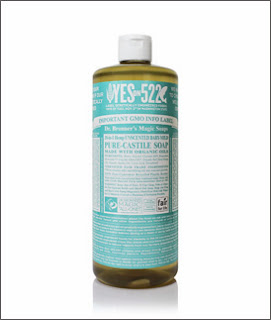
So, what does one who wants to lead a more green and natural lifestyle do? Run to your local Target, drug store, or health food store, and pick up a bottle of Dr. Bronner's Magic Pure Castile Classic Liquid Soap. You know the one I'm talking about - that plastic bottle of clear, amber-colored liquid with all the crazy writing on the label.
From their website:
Dr. Bronner's comes in several scents, but my sensitive skin and I prefer the unscented, "Baby Mild" formula (pictured above).
Apply the soap directly to your face. Work it in so that you break down all the makeup. Just be careful not to get any of the soap into your eyes - IT WILL STING.
Once you're confident that you've worked the soap into getting every bit of makeup on your face (takes me about a minute or two), rinse off well with water et voilà! Your face should be spick-and-span! Even the waterproof mascara - no sign whatsoever!
(NOTE: In this video, you'll see that I have some black marks on my hands. I wrote on the back of my hands with a black Sharpie before applying the makeup so that I could tell which cleanser I used on which hand. If you look carefully, you can see that one says "cleansing oil" and the other "Dr. Bronner's." I just want to make it clear that the marks are not from leftover makeup.)
The only thing that I've noticed is that Dr. Bronner soaps tend to leave a little bit of a squeaky feeling on your skin. I think it's a characteristic of using an all natural, oil-based soap rather than it being the result of any sort of residue. But if you're used to a more slick feeling after washing your face, just follow it up with a quick once-over with your regular, daily cleanser.
How much will a bottle of Dr. Bronner's set you back? I bought a 32 oz bottle from Target for $16.99. Go to town!
As I mentioned before, cleansing oils are more of an Asian thing. Although cleansing oils are gaining popularity here in the States, it still tends to be the Asian brands that make them (e.g. Shu Uemura and Shiseido, to name a couple).
You can generally find these at your local Sephora or department store counter, but these brands tend to be a little pricey. As I write this, a 150 mL (5 oz) bottle of a Shu Uemura cleansing oil is upwards of $31 (USD), and a 450 mL (15-16 oz) bottle is upwards of $67.
If you have an Asian grocery store near you, you may be able to find a more reasonably priced bottle of cleansing oil in their cosmetics aisle. My last one came from my local Mitsuwa - a 150 mL bottle of cleansing oil from Kracie's Purenavi line ($15).
Now, here's the thing - the main ingredient in most of these cleansing oils is mineral oil. You can find mineral oil in many cosmetic products, from high end moisturizers to your run-of-the-mill baby oil. People have used it for ages - it does the job.
But what is it exactly? The name "mineral oil" sounds like it could be a type of fancy essential oil derived from natural minerals... Alas, a quick search on the internet will tell you the truth: it's a petroleum by-product. Yes, "petroleum," as in Vaseline, fossil fuels and crude oil. "Petroleum," as in it could be harmful to your skin and overall health.
So, what does one who wants to lead a more green and natural lifestyle do? Run to your local Target, drug store, or health food store, and pick up a bottle of Dr. Bronner's Magic Pure Castile Classic Liquid Soap. You know the one I'm talking about - that plastic bottle of clear, amber-colored liquid with all the crazy writing on the label.

From their website:
Unlike any you’ve ever used. A combination of organic extra virgin coconut, olive, jojoba and hemp oils, together with pure essential oils, creates a unique soap that cleans effectively without being aggressive and produces a velvety-lather that leaves the skin silky-smooth and refreshed.Sure, you could use a bottle of any regular, natural oil (jojoba, olive, coconut, etc.) to work in and wipe off, but that method tends to leave greasy messes both on your face and in your sink. Not only is Dr. Bronner's made from organic, natural oils, but it's formulated so that it rinses off clean.
- Completely Biodegradable and Vegetable-Based
- Made with Certified Fair Trade and Organic Oils
- Multi-Purpose: 18-in-1 Uses
- No Synthetic Foaming Agents, Thickeners or Preservatives
- 100% Post-Consumer Recycled (PCR) Cylinder Bottles and Paper Labels
- Simple, Ecological Formulations Based on Old-World Quality and Expertise
- #1-Selling Natural Brand of Soaps in North America
INGREDIENTS: Water, Saponified Organic Coconut*, Organic Palm* and Organic Olive* Oils (w/Retained Glycerin), Organic Hemp Oil, Organic Jojoba Oil, Essential Oils**, Citric Acid, Vitamin E
* FAIR TRADE Ingredients
** Available in Peppermint, Lavender, Almond, Tea Tree, Eucalyptus, Rose and Citrus Orange
Dr. Bronner's comes in several scents, but my sensitive skin and I prefer the unscented, "Baby Mild" formula (pictured above).
Directions
How do you use it? Not too different from how you would use a cleansing oil. Starting with a dry face, put about half a tablespoon or so of the liquid soap in your hand. Mix in a little bit of water (the soap needs to be diluted for easier use). Some sudsing is okay.Apply the soap directly to your face. Work it in so that you break down all the makeup. Just be careful not to get any of the soap into your eyes - IT WILL STING.
Once you're confident that you've worked the soap into getting every bit of makeup on your face (takes me about a minute or two), rinse off well with water et voilà! Your face should be spick-and-span! Even the waterproof mascara - no sign whatsoever!
(NOTE: In this video, you'll see that I have some black marks on my hands. I wrote on the back of my hands with a black Sharpie before applying the makeup so that I could tell which cleanser I used on which hand. If you look carefully, you can see that one says "cleansing oil" and the other "Dr. Bronner's." I just want to make it clear that the marks are not from leftover makeup.)
The only thing that I've noticed is that Dr. Bronner soaps tend to leave a little bit of a squeaky feeling on your skin. I think it's a characteristic of using an all natural, oil-based soap rather than it being the result of any sort of residue. But if you're used to a more slick feeling after washing your face, just follow it up with a quick once-over with your regular, daily cleanser.
How much will a bottle of Dr. Bronner's set you back? I bought a 32 oz bottle from Target for $16.99. Go to town!
Thursday, June 6, 2013
Pretty in Pink Ribbons: Health and Cosmetics
This time last year, I was in South Korea on business. While there, I had the pleasure of attending the International Women's Film Festival in Seoul, where I watched an eye-opening documentary about cause marketing, called Pink Ribbons, Inc. (2011, Dir.
Léa Pool).
From the film's website:
Trailer
Needless to say, my mind was blown after watching this. That's not to say that I was completely ignorant of the subject matter. I've been aware of various online databases that list and rate carcinogens in cosmetics for several years now. I know many (most, I should say) cosmetics and skin care products contain various chemicals that are suspected to be carcinogens (at the time of this writing) and that many of these same cosmetics companies promote breast cancer awareness and research. The hypocrisy of it all is pretty obvious, but I just never cared enough nor was skeptical enough to connect the dots and put it all together the way this documentary did for me.
It isn't hard to find all natural cosmetics and skin care products these days. Many companies have jumped on the "natural" and "organic" bandwagons in the last few years (cue buzzword "paraben-free"), making these products more accessible to a wider market. Walk into any CVS or Target, and you'll find entire shelves in the beauty section devoted to natural products. Many are still a bit pricier than your run-of-the-mill drugstore brands, but I would say that it's similar to the difference of buying organic vs. non-organic food. Whether the extra cost is worth it to you financially, and personally, is for you to decide.
Online cosmetics safety databases:
Where you can watch Pink Ribbons, Inc.:
From the film's website:
The ubiquitous pink ribbons of breast cancer philanthropy – and the hand-in-hand marketing of brands and products associated with that philanthropy – permeates our culture, providing assurance that we are engaged in a successful battle against this insidious disease. But the campaign obscures the reality and facts of breast cancer – more and more women are diagnosed with breast cancer every year, and face the same treatment options they did 40 years ago. Yet women are also the most influential market group, buying 80 percent of consumer products and making most major household purchasing decisions. So then who really benefits from the pink ribbon campaigns – the cause or the company? And what if the very companies and products that profit from their association have actually contributed to the problem?
In showing the real story of breast cancer and the lives of those who fight it, Pink Ribbons, Inc. reveals the co-opting of what marketing experts have labeled a "dream cause."
Needless to say, my mind was blown after watching this. That's not to say that I was completely ignorant of the subject matter. I've been aware of various online databases that list and rate carcinogens in cosmetics for several years now. I know many (most, I should say) cosmetics and skin care products contain various chemicals that are suspected to be carcinogens (at the time of this writing) and that many of these same cosmetics companies promote breast cancer awareness and research. The hypocrisy of it all is pretty obvious, but I just never cared enough nor was skeptical enough to connect the dots and put it all together the way this documentary did for me.
It isn't hard to find all natural cosmetics and skin care products these days. Many companies have jumped on the "natural" and "organic" bandwagons in the last few years (cue buzzword "paraben-free"), making these products more accessible to a wider market. Walk into any CVS or Target, and you'll find entire shelves in the beauty section devoted to natural products. Many are still a bit pricier than your run-of-the-mill drugstore brands, but I would say that it's similar to the difference of buying organic vs. non-organic food. Whether the extra cost is worth it to you financially, and personally, is for you to decide.
Online cosmetics safety databases:
- Cosmeticsinfo.org - "Your source for safety information about cosmetic and personal care products, their ingredients and how they are tested and regulated."
- Environmental Working Group's Skin Deep® - A database that "provides easy-to-navigate safety ratings for tens of thousands of personal care products."
Where you can watch Pink Ribbons, Inc.:
- Netflix
- Buy the DVD
- Download (Canada only)
- Rent for 48 hours (Canada only)
Monday, July 27, 2009
Budget-friendly Beauty: Jojoba Oil
In the last few years or so, I started developing an interest in natural skincare products. I could go on and on about this topic but, to make a long story short, I got on a "natural, chemical-free" products kick and decided that it would be better for my problem skin in the long run.
This led me to start researching various companies and cosmetics lines for products that were deemed "organic" and "natural" and could help my skin become more healthy. I started out with Dr. Hauschka, then moved onto Zia, and, with a smattering of various other products in between, my last major investment was with Lush. While I loved their skincare products, there was a slight problem with my continued use of them: they are expensive. Dr. Hauschka's products average around $40 each, and the small jars of moisturizers I purchased from Lush are both around $30 each. Yes, it may be worth it to spend a little more money for quality products, but it's no good if you don't have much money to begin with.
My last major "organic," "all-natural" purchase was Josie Maran's argan oil, which was literally a $50 (small) bottle of oil. No additives or "infusions"; just plain oil. Speaking as someone with oily skin, you'd think that using oil as a moisturizer would defeat the purpose of maintaining good skin. Seriously, though, it was probably more effective at balancing out my oily skin than a mattifier or something that was oil-free (don't want to really get into a long discussion, but basically the idea that trying to dry out your skin only makes it produce more oil). In the end, I felt like the bottle of argan oil was a worthy purchase, but probably something that I wouldn't get again.
So, what to do? Was it possible for me to get a decent, natural moisturizer without racking up the credit card debt? Yes, and that answer came in the form of jojoba oil.

I first came across the idea of using plain jojoba oil as a moisturizer on Daniel Kern's Acne.org website. According to many sources, including him, jojoba oil is the closest to your skin's natural oils than are other vegetable oils (which are included in most, if not all moisturizers, "all-natural" or otherwise) and is non-comedogenic (i.e. it won't clog your pores). But the best part is that a 4 oz. bottle only costs around $10, and since I only use 3-5 drops at a time, this will probably last me at least a year.
I've been using jojoba oil for a few months now (after having used argan oil for about 6 months), and my skin continues to feel soft and healthy (well, as healthy as it can be, considering...). Also, since I'm using just the oil, there aren't any additives to irritate my skin, which can happen even with many natural skincare products.
If you're looking for a good, inexpensive moisturizer for your skincare routine, I highly recommend grabbing yourself a bottle of jojoba oil. Even if it doesn't agree with your face, its many other uses (body moisturizer, makeup remover, hair care, etc.) will still make it a good investment.
Tuesday, March 10, 2009
Budget-friendly Beauty: DIY Body Scrub
A day late, I know. Sorry! :-I
Anyway, this time, rather than highlighting a product for purchase, I thought I'd share a little do-it-yourself project with you. I know; very "Martha Stewart" of me.
If you are like me, your bedroom/bathroom/storage closet is abundant with various body creams, butters, milks, and/or lotions. Birthdays, Christmas, random "Thank You" gifts - there's always at least a few people who decide to give you random skin care gift baskets. The problem is, it's always more than you could ever use in your lifetime.

So, what to do with all these bath and body goodies? Well, other than re-gifting them, you can actually put them to use!
You know all those body scrubs you find at the store? Yes, exfoliation is key to good-looking skin, but that stuff is not cheap! Now, you don't have to bother wasting your money on that stuff. You can make your own at home at little to no cost. All you need is that bottle or jar of whatever moisturizer you're trying to get rid of and some sugar (you can use salt if you want, but sugar doesn't sting or irritate your skin like salt can). Some people recommend raw sugar (the stuff that's in those brown packets at Starbucks), but plain white sugar is better for your skin since it's finer in grain (won't be as rough). And, last time I checked, a pound of white sugar only cost a couple of bucks.
In regards to the recipe: mix sugar and moisturizer, and apply like any other body scrub (massage onto skin and rinse). Most recipes recommend one part sugar to one part moisturizer, but since you're the one making it, feel free to use as much of either as you want. Also, I usually mix enough for one application at a time, so I don't know how long it'll keep if you mix the entire thing (although, I assume fairly long due to the amount of sugar needed).
And voilà! Good looking (and feeling!) skin, and you barely have to open your wallet! Happy mixing!
Monday, January 26, 2009
Budget-friendly Beauty: Cetaphil Daily Facial Cleanser
Although I love working for myself and being able to create my own schedule, I do find myself with a lot of down time every so often. A lot. And, unfortunately, this happens to be one of those times. So, to help me keep my hands from being idle, I've decided to start a new biweekly series here on my blog: Budget-friendly Beauty (yeah, no clever title here). In this series, I'll feature some of my favorite inexpensive products - a perfect complement to current times. Many of you may already be familiar with the products I'll be discussing, but for those of you who aren't, this is the place to familiarize yourself.
First up is the Cetaphil Daily Facial Cleanser for Normal to Oily Skin.

Cetaphil's Gentle Skin Cleanser is already a big favorite among many people (and multiple beauty award winner). Unfortunately, I find it a little too creamy and moisturizing for my oily skin (it's probably great for people with dry skin or those who live in extreme winter climates). Unlike the Gentle Skin Cleanser, the Daily Facial Cleanser is more like a face wash gel: it lathers up and rinses off clean. What I like about this particular cleanser, however, is that, while it's gentle and doesn't leave your skin tight and dry, it's still able to take off most, if not all of the grime on your face.
Now, many of you who are used to department store stuff probably shun the idea of using drugstore skin care products. And, for the most part, I would agree with you. Most of my forays into drugstore skin care has left me SORELY disappointed. And not just in a snobby sort of way. Most of that stuff has so much alcohol, fragrance, and other chemicals in it that it really does leave your skin for the worse. Cetaphil, however, is one of the few exceptions.
No, it doesn't contain all those fancy vitamins and minerals that promise to leave your skin looking fresh and radiant and a thousand years younger. ... But, guess what. All that stuff, when put in a face wash, is useless anyway. Why? Because you end up washing it all off before it has a chance to do anything for your skin. Your money is literally going down the drain. In the end, all you really need from a face wash is something that will leave your face clean and ready to go, and Cetaphil is something that will give you that at a decent price.
So, the next time you're looking to invest in a face wash, head over to your local Target, drugstore, etc., and give Cetaphil a try.
Saturday, November 22, 2008
Finding the Right Skin Care for Your Age
The other day, I was perusing the skin care aisle at Target and encountered two tween girls in serious deliberation. Girl A held up a motorized facial scrubber and insisted that it was the secret behind her great skin (mind you, these girls were at that age where they still have peach fuzz on their cheeks). Girl B was torn. She probably thought that the price was a little too steep for her allowance, but she ended up putting the mini face-sander into her basket anyway. Did either of these girls need this thing? Most likely not. But why did they buy it? Because they weren't aware that this product was not meant for them.
I think the same thing happens with people our age, in our 20s, 30s, and 40s. So many products exist in the world of skin care, all making (empty) promises of youth and beauty, and many of us (myself included) get sucked in. Unfortunately, many of us are also not yet ready to use some of these products either. For instance, did you know that people in their 20s (and some in their 30s) should stay away from anti-wrinkle and firming creams? Many women (and men) use these products as preventative treatments, but that's not how these things work. Most of these products "firm" the skin by tightening it and, subsequently, making it thin. Imagine what would happen to your skin if you started using these products prematurely. It would be like getting a face lift right now, albeit not that drastic. In the long run, though, you'd end up having to use more product and resort to stronger and even more drastic treatments later on down the line.
TotalBeauty.com, an online resource for - you guessed it - beauty and beauty products, has some tips for age-appropriate skin care. They break down what kinds of products you should use between ages 20 through 50, and they also include some product suggestions. According to them, people in their 20s, for instance, really only need to wash, moisturize, and treat specific skin conditions, like acne. They don't recommend daily exfoliation until your 30s, and no wrinkle treatments until you reach your 40s.
Total Beauty also has a skin analysis quiz, which is helpful in determining what kind of skin type you have, so that you can make more informed choices for your skin care regimen.
Subscribe to:
Posts (Atom)