A couple of years ago, I wrote about the state of Minnesota banning products containing triclosan, which is the main antibacterial ingredient in most antibacterial soaps, body washes, and hand sanitizers. Now, the FDA has jumped on board and is no longer approving the use of several ingredients (triclosan being one of them) in soaps and body washes.
As I pointed out in the previous post, triclosan has been associated with bacterial resistance to drugs and antibiotics, as well as hormone disruption in animals and human beings (as a result of overuse and our environment being subsequently contaminated with the chemical).
However, the biggest determining factor, and perhaps the most important, is that antibacterial soap manufacturers have been UNABLE TO PROVE that their products are more effective than plain soap and water. It is probably safe to assume that it was all a gimmick to sell more soap.
Antibacterial hand soaps and body washes containing triclosan and the other list of ingredients will no longer be available in the U.S. within one year of the ruling. In other cases, I would recommend people stocking up before everything was pulled from the shelves. Not in this case, though. NEVER in this case.
Showing posts with label environment. Show all posts
Showing posts with label environment. Show all posts
Sunday, September 4, 2016


Friday, May 23, 2014
Minnesota Bans Antibacterial Ingredient. You Probably Should, Too.

Triclosan. It's found in our favorite antibacterial hand soaps, body washes, hand sanitizers, tooth paste, cosmetics, deodorant... It's in a lot of stuff.
It has also been banned in Minnesota.
I've always been a skeptic when it comes to many things. I can't say that I didn't fall for the antibacterial gimmick when it first began picking up steam in the '90s, or that I don't fall for it whenever I end up coming into contact with... not-so-clean things, but I always wondered if the draw towards those products weren't so much science as it was marketing. Now, I know the answer.
Recently, the Food and Drug Administration (FDA) proposed a rule that would require manufacturers of antibacterial products "to prove their products are more effective than plain soap and water in preventing illness and the spread of infection."
According to CNN:
"Millions of Americans use antibacterial hand soap and body wash products," the [FDA] said in a statement. "Although consumers generally view these products as effective tools to help prevent the spread of germs, there is currently no evidence that they are any more effective at preventing illness than washing with plain soap and water."
You may ask, "So what if it's not more effective?" It may not be any better, but it couldn't be any worse. Better to be safe than sorry, right?
Not necessarily right. In fact, according to some research, it's plenty worse. Not only are antibacterial products contributing to bacterial resistance to drugs and antibiotics, they're also being accused of disrupting hormones in our bodies.
Since I'm not an expert in this field, I can only share with you the literature that I have come across on this topic (links to which you'll find throughout this post). Even though I feel many of the statements made in these articles are compelling, it's ultimately up to you to determine for yourself the legitimacy of these findings.
For more information about the FDA's position on triclosan, please visit:
http://www.fda.gov/forconsumers/consumerupdates/ucm205999.htm
Saturday, October 26, 2013
Dr. Bronner's Magic Pure Castile Classic Liquid Soap: A Natural, Green Alternative to Makeup Cleansing Oils
I'm not gonna lie; I'm an extremely lazy person. I simply cannot be bothered when it comes to removing makeup. Why do we need so much cleansing and wiping? That's why I find cleansing oils so wonderful. I can remove a full face of makeup in one easy step. I mean, think of all the waste in cotton pads and tissues! Think of your raw, irritated skin!!! Why put yourself through all of that when a good cleansing oil will take care of everything???
As I mentioned before, cleansing oils are more of an Asian thing. Although cleansing oils are gaining popularity here in the States, it still tends to be the Asian brands that make them (e.g. Shu Uemura and Shiseido, to name a couple).
You can generally find these at your local Sephora or department store counter, but these brands tend to be a little pricey. As I write this, a 150 mL (5 oz) bottle of a Shu Uemura cleansing oil is upwards of $31 (USD), and a 450 mL (15-16 oz) bottle is upwards of $67.
If you have an Asian grocery store near you, you may be able to find a more reasonably priced bottle of cleansing oil in their cosmetics aisle. My last one came from my local Mitsuwa - a 150 mL bottle of cleansing oil from Kracie's Purenavi line ($15).
Now, here's the thing - the main ingredient in most of these cleansing oils is mineral oil. You can find mineral oil in many cosmetic products, from high end moisturizers to your run-of-the-mill baby oil. People have used it for ages - it does the job.
But what is it exactly? The name "mineral oil" sounds like it could be a type of fancy essential oil derived from natural minerals... Alas, a quick search on the internet will tell you the truth: it's a petroleum by-product. Yes, "petroleum," as in Vaseline, fossil fuels and crude oil. "Petroleum," as in it could be harmful to your skin and overall health.
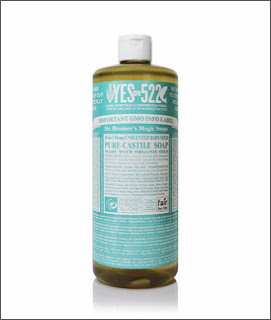
So, what does one who wants to lead a more green and natural lifestyle do? Run to your local Target, drug store, or health food store, and pick up a bottle of Dr. Bronner's Magic Pure Castile Classic Liquid Soap. You know the one I'm talking about - that plastic bottle of clear, amber-colored liquid with all the crazy writing on the label.
From their website:
Dr. Bronner's comes in several scents, but my sensitive skin and I prefer the unscented, "Baby Mild" formula (pictured above).
Apply the soap directly to your face. Work it in so that you break down all the makeup. Just be careful not to get any of the soap into your eyes - IT WILL STING.
Once you're confident that you've worked the soap into getting every bit of makeup on your face (takes me about a minute or two), rinse off well with water et voilà! Your face should be spick-and-span! Even the waterproof mascara - no sign whatsoever!
(NOTE: In this video, you'll see that I have some black marks on my hands. I wrote on the back of my hands with a black Sharpie before applying the makeup so that I could tell which cleanser I used on which hand. If you look carefully, you can see that one says "cleansing oil" and the other "Dr. Bronner's." I just want to make it clear that the marks are not from leftover makeup.)
The only thing that I've noticed is that Dr. Bronner soaps tend to leave a little bit of a squeaky feeling on your skin. I think it's a characteristic of using an all natural, oil-based soap rather than it being the result of any sort of residue. But if you're used to a more slick feeling after washing your face, just follow it up with a quick once-over with your regular, daily cleanser.
How much will a bottle of Dr. Bronner's set you back? I bought a 32 oz bottle from Target for $16.99. Go to town!
As I mentioned before, cleansing oils are more of an Asian thing. Although cleansing oils are gaining popularity here in the States, it still tends to be the Asian brands that make them (e.g. Shu Uemura and Shiseido, to name a couple).
You can generally find these at your local Sephora or department store counter, but these brands tend to be a little pricey. As I write this, a 150 mL (5 oz) bottle of a Shu Uemura cleansing oil is upwards of $31 (USD), and a 450 mL (15-16 oz) bottle is upwards of $67.
If you have an Asian grocery store near you, you may be able to find a more reasonably priced bottle of cleansing oil in their cosmetics aisle. My last one came from my local Mitsuwa - a 150 mL bottle of cleansing oil from Kracie's Purenavi line ($15).
Now, here's the thing - the main ingredient in most of these cleansing oils is mineral oil. You can find mineral oil in many cosmetic products, from high end moisturizers to your run-of-the-mill baby oil. People have used it for ages - it does the job.
But what is it exactly? The name "mineral oil" sounds like it could be a type of fancy essential oil derived from natural minerals... Alas, a quick search on the internet will tell you the truth: it's a petroleum by-product. Yes, "petroleum," as in Vaseline, fossil fuels and crude oil. "Petroleum," as in it could be harmful to your skin and overall health.
So, what does one who wants to lead a more green and natural lifestyle do? Run to your local Target, drug store, or health food store, and pick up a bottle of Dr. Bronner's Magic Pure Castile Classic Liquid Soap. You know the one I'm talking about - that plastic bottle of clear, amber-colored liquid with all the crazy writing on the label.

From their website:
Unlike any you’ve ever used. A combination of organic extra virgin coconut, olive, jojoba and hemp oils, together with pure essential oils, creates a unique soap that cleans effectively without being aggressive and produces a velvety-lather that leaves the skin silky-smooth and refreshed.Sure, you could use a bottle of any regular, natural oil (jojoba, olive, coconut, etc.) to work in and wipe off, but that method tends to leave greasy messes both on your face and in your sink. Not only is Dr. Bronner's made from organic, natural oils, but it's formulated so that it rinses off clean.
- Completely Biodegradable and Vegetable-Based
- Made with Certified Fair Trade and Organic Oils
- Multi-Purpose: 18-in-1 Uses
- No Synthetic Foaming Agents, Thickeners or Preservatives
- 100% Post-Consumer Recycled (PCR) Cylinder Bottles and Paper Labels
- Simple, Ecological Formulations Based on Old-World Quality and Expertise
- #1-Selling Natural Brand of Soaps in North America
INGREDIENTS: Water, Saponified Organic Coconut*, Organic Palm* and Organic Olive* Oils (w/Retained Glycerin), Organic Hemp Oil, Organic Jojoba Oil, Essential Oils**, Citric Acid, Vitamin E
* FAIR TRADE Ingredients
** Available in Peppermint, Lavender, Almond, Tea Tree, Eucalyptus, Rose and Citrus Orange
Dr. Bronner's comes in several scents, but my sensitive skin and I prefer the unscented, "Baby Mild" formula (pictured above).
Directions
How do you use it? Not too different from how you would use a cleansing oil. Starting with a dry face, put about half a tablespoon or so of the liquid soap in your hand. Mix in a little bit of water (the soap needs to be diluted for easier use). Some sudsing is okay.Apply the soap directly to your face. Work it in so that you break down all the makeup. Just be careful not to get any of the soap into your eyes - IT WILL STING.
Once you're confident that you've worked the soap into getting every bit of makeup on your face (takes me about a minute or two), rinse off well with water et voilà! Your face should be spick-and-span! Even the waterproof mascara - no sign whatsoever!
(NOTE: In this video, you'll see that I have some black marks on my hands. I wrote on the back of my hands with a black Sharpie before applying the makeup so that I could tell which cleanser I used on which hand. If you look carefully, you can see that one says "cleansing oil" and the other "Dr. Bronner's." I just want to make it clear that the marks are not from leftover makeup.)
The only thing that I've noticed is that Dr. Bronner soaps tend to leave a little bit of a squeaky feeling on your skin. I think it's a characteristic of using an all natural, oil-based soap rather than it being the result of any sort of residue. But if you're used to a more slick feeling after washing your face, just follow it up with a quick once-over with your regular, daily cleanser.
How much will a bottle of Dr. Bronner's set you back? I bought a 32 oz bottle from Target for $16.99. Go to town!
Thursday, June 6, 2013
Pretty in Pink Ribbons: Health and Cosmetics
This time last year, I was in South Korea on business. While there, I had the pleasure of attending the International Women's Film Festival in Seoul, where I watched an eye-opening documentary about cause marketing, called Pink Ribbons, Inc. (2011, Dir.
Léa Pool).
From the film's website:
Trailer
Needless to say, my mind was blown after watching this. That's not to say that I was completely ignorant of the subject matter. I've been aware of various online databases that list and rate carcinogens in cosmetics for several years now. I know many (most, I should say) cosmetics and skin care products contain various chemicals that are suspected to be carcinogens (at the time of this writing) and that many of these same cosmetics companies promote breast cancer awareness and research. The hypocrisy of it all is pretty obvious, but I just never cared enough nor was skeptical enough to connect the dots and put it all together the way this documentary did for me.
It isn't hard to find all natural cosmetics and skin care products these days. Many companies have jumped on the "natural" and "organic" bandwagons in the last few years (cue buzzword "paraben-free"), making these products more accessible to a wider market. Walk into any CVS or Target, and you'll find entire shelves in the beauty section devoted to natural products. Many are still a bit pricier than your run-of-the-mill drugstore brands, but I would say that it's similar to the difference of buying organic vs. non-organic food. Whether the extra cost is worth it to you financially, and personally, is for you to decide.
Online cosmetics safety databases:
Where you can watch Pink Ribbons, Inc.:
From the film's website:
The ubiquitous pink ribbons of breast cancer philanthropy – and the hand-in-hand marketing of brands and products associated with that philanthropy – permeates our culture, providing assurance that we are engaged in a successful battle against this insidious disease. But the campaign obscures the reality and facts of breast cancer – more and more women are diagnosed with breast cancer every year, and face the same treatment options they did 40 years ago. Yet women are also the most influential market group, buying 80 percent of consumer products and making most major household purchasing decisions. So then who really benefits from the pink ribbon campaigns – the cause or the company? And what if the very companies and products that profit from their association have actually contributed to the problem?
In showing the real story of breast cancer and the lives of those who fight it, Pink Ribbons, Inc. reveals the co-opting of what marketing experts have labeled a "dream cause."
Needless to say, my mind was blown after watching this. That's not to say that I was completely ignorant of the subject matter. I've been aware of various online databases that list and rate carcinogens in cosmetics for several years now. I know many (most, I should say) cosmetics and skin care products contain various chemicals that are suspected to be carcinogens (at the time of this writing) and that many of these same cosmetics companies promote breast cancer awareness and research. The hypocrisy of it all is pretty obvious, but I just never cared enough nor was skeptical enough to connect the dots and put it all together the way this documentary did for me.
It isn't hard to find all natural cosmetics and skin care products these days. Many companies have jumped on the "natural" and "organic" bandwagons in the last few years (cue buzzword "paraben-free"), making these products more accessible to a wider market. Walk into any CVS or Target, and you'll find entire shelves in the beauty section devoted to natural products. Many are still a bit pricier than your run-of-the-mill drugstore brands, but I would say that it's similar to the difference of buying organic vs. non-organic food. Whether the extra cost is worth it to you financially, and personally, is for you to decide.
Online cosmetics safety databases:
- Cosmeticsinfo.org - "Your source for safety information about cosmetic and personal care products, their ingredients and how they are tested and regulated."
- Environmental Working Group's Skin Deep® - A database that "provides easy-to-navigate safety ratings for tens of thousands of personal care products."
Where you can watch Pink Ribbons, Inc.:
- Netflix
- Buy the DVD
- Download (Canada only)
- Rent for 48 hours (Canada only)
Wednesday, November 26, 2008
Back to MAC Program
Hey everyone. Happy Turkey Day Eve!
Makeup fanatic or not, I think pretty much everyone who is familiar with cosmetics is familiar with MAC.

And people who are familiar with MAC are also familiar with its charity work through the MAC Aids Fund. But did you know that MAC also has a program dedicated to environmental causes?
The Back to MAC Program is a recycling service MAC provides to its customers, along with an added incentive. Return any six MAC "primary packaging containers" (i.e. used/empty MAC eyeshadow containers, foundation bottles, lipstick tubes, etc.) and receive a free lipstick (Viva Glam lipsticks excluded). You can take advantage of this offer at any MAC counter or on MAC's website.
While I, personally, would rather choose to save myself the postage costs and go to my nearest store, I understand some of you might want to mail it in. For those of you who choose the latter, print and fill out this form. All the instructions are there.
Makeup fanatic or not, I think pretty much everyone who is familiar with cosmetics is familiar with MAC.

And people who are familiar with MAC are also familiar with its charity work through the MAC Aids Fund. But did you know that MAC also has a program dedicated to environmental causes?
The Back to MAC Program is a recycling service MAC provides to its customers, along with an added incentive. Return any six MAC "primary packaging containers" (i.e. used/empty MAC eyeshadow containers, foundation bottles, lipstick tubes, etc.) and receive a free lipstick (Viva Glam lipsticks excluded). You can take advantage of this offer at any MAC counter or on MAC's website.
While I, personally, would rather choose to save myself the postage costs and go to my nearest store, I understand some of you might want to mail it in. For those of you who choose the latter, print and fill out this form. All the instructions are there.
Subscribe to:
Posts (Atom)